
⭐ Scientific References (Prelude to the Phase Gap)
The ideas in this episode build on earlier mathematical work by Radek M. Sobczynski, published in the DigitalCommons@Fairfield University repository. These papers do not yet discuss the phase defect directly — instead, they establish the structural foundations that later make the existence of the phase gap unavoidable.
1. Sobczynski, Radek M. (2025)
“The 2πe Quantization Rule in exp(iθ): Discovery Through Extreme‑Precision Computation.”
International Journal of Computer and Systems Engineering, Vol. 4, Iss. 2, Article 1.
Available at: https://digitalcommons.fairfield.edu/ijcase/vol4/iss2/1
This paper identifies the 2πe threshold as a structural requirement for rotational closure in the complex exponential. It lays the groundwork for understanding why finite approximations inevitably fall short.
2. Sobczynski, Radek M. (2026)
“Per‑Period Rotation‑Closure Theorem: A 17|18‑Term Invariant for Euler Rotations.”
International Journal of Computer and Systems Engineering, Vol. 5, Iss. 1, Article 1.
Available at: https://digitalcommons.fairfield.edu/ijcase/vol5/iss1/1
This work establishes the 17|18‑term closure invariant — a structural limit showing that finite polynomials cannot perfectly reproduce a full rotation. This invariant is the mathematical ancestor of the phase defect explored in Mandarax.
Credit: Radek M. Sobczynski ©
🎧 COLD OPEN — SOUND UP
SFX: Soft hum. A sine wave. Slowly bending. A faint click every few seconds.
NARRATOR (calm, American, Radiolab tone): ...A circle. The simplest shape we know. But imagine a circle that isn’t drawn on paper… a circle that moves. A circle that stretches, contracts, breathes — like a slinky made of light, looping through space, chasing its own tail across the fabric of the universe.
And yet… long before we could imagine a circle drifting through the cosmos, the circle on the ground was already a problem.
From the dawn of time, the Greeks stared at this shape and felt something unsettling. How do you measure a curve that never straightens? How do you slice perfection into pieces? How do you capture a boundary that refuses to close cleanly in numbers?
They tried chords, polygons, ratios — anything to trap the circle in geometry. But every time they tightened the net, the circle slipped through, leaving behind a number that stretched on forever...
MANDARAX (American woman, amused; highly educated): All right. It is me Mandarax -- in case you had not guessed... Enough staring. Let us step inside the circle. Not the drawing, not the symbol, but the thing itself. The living loop. The engine of rotation that has been hiding in plain sight since the first human picked up a stick and tried to measure the world. If you really want to understand what the circle is doing, you have to follow it from the inside.
TURTLE (calm, slow): Mandarax. Slow down.... Before we can follow it, we need to understand what this circle really is... And since we are talking about circles, I should probably introduce myself. I am the Turtle. Yes -- that Turtle. The one from Zeno's story. The one Achilles can never catch.
SFX: Footsteps. Sand. A runner breathing.
ACHILLES (Greek accent, slightly breathless): “I have been walking this paradox for a very long time. And speaking of me ... Achilles… perhaps it is time for me express my frustration!!! I can outrun anyone. Anyone!
But TURTLE says I cannot reach this… this circle.
SFX: Hum deepens. A low, cosmic wobble.
MANDARAX: Oh sweetheart… buckle up.
MUSIC: Radiolab‑style plucked strings fade in, playful but curious.
🟦 ACT I — “THE CHASE”
NARRATOR: So, Achilles — yes, that Achilles — is staring at a perfect circle like it owes him money.
ACHILLES (frustrated): “Because π never ends! What kind of madness is this?”
TURTLE (slow, calm): “Achilles… π is transcendental. It never repeats. Never settles.”
SFX: A pencil draws a circle. The line loops, loops, loops… then glitches.
MANDARAX (warm tone): You can reach the circle just fine. What you can’t reach is the last digit of π — because there isn’t one.
NARRATOR: And that’s where our story begins. A perfect shape… described by an imperfect number.
🟧 ACT II — “THE IMPOSTOR ROTATION”
SFX: A chalkboard. Equations scribbling fast.
ACHILLES: “TURTLE says polynomials cannot rotate properly. How can this be?”
TURTLE: “Take the exponential. eiθ. Perfect periodicity. Every 2π, you return home.”
SFX: A clean, pure tone looping every few seconds.
MANDARAX (American, teasing): But the Taylor polynomial? Oh honey… that thing is a finite machine pretending to be infinite.
SFX: The tone tries to loop… but drifts. A tiny phase slip.
ACHILLES: “So it is like me chasing the circle — always close, never perfect?”
MANDARAX: Exactly.
🟥 ACT III — “THE UNIVERSE CHEATS”
NARRATOR: Mandarax leans in. The room gets quiet.
MANDARAX (low, conspiratorial): There are only two possibilities.
SFX: Two tones alternate: one pure, one distorted.
NARRATOR: Option A: The universe performs infinite algebra every time something rotates.
SFX: A massive, impossible chord — too many notes.
NARRATOR: Option B: It cheats. Uses a finite polynomial. Accepts a microscopic defect — a phase drift.
ACHILLES (horrified): “A defect? In my circle?”
TURTLE (dry): “Yes. A very small one. Until it is not.”
🟩 ACT IV — “THE 17|18 CADENCE”
SFX: Clicks. Like a metronome. But irregular.
NARRATOR: Achilles thinks the universe chooses between 17 and 18 terms once. Mandarax sighs.
MANDARAX: No, darling. It chooses 17 or 18 every rotation.
TURTLE: “After eight rotations, the index is 136 or 137.”
ACHILLES (stunned): “So the universe is not choosing between teenagers… it is choosing between old men!”
MANDARAX (laughing): Exactly.
SFX: A sudden collapse — the phase gap shrinks dramatically.
NARRATOR: At 143 or 144 terms… the drift collapses by five orders of magnitude.
🟪 ACT V — “THE CHIRP”
ACHILLES: “So what happens after ten to the thirty‑third oscillations?”
SFX: A whisper. A faint rising tone.
MANDARAX (whispering): The closure isn’t perfect. There’s a leftover. A tiny sliver of phase.
ACHILLES: “How tiny?”
MANDARAX: So tiny you’d laugh… until you multiply it by 1033.
TURTLE: “We call it the phase chirp.”
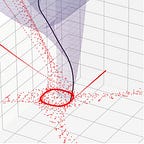
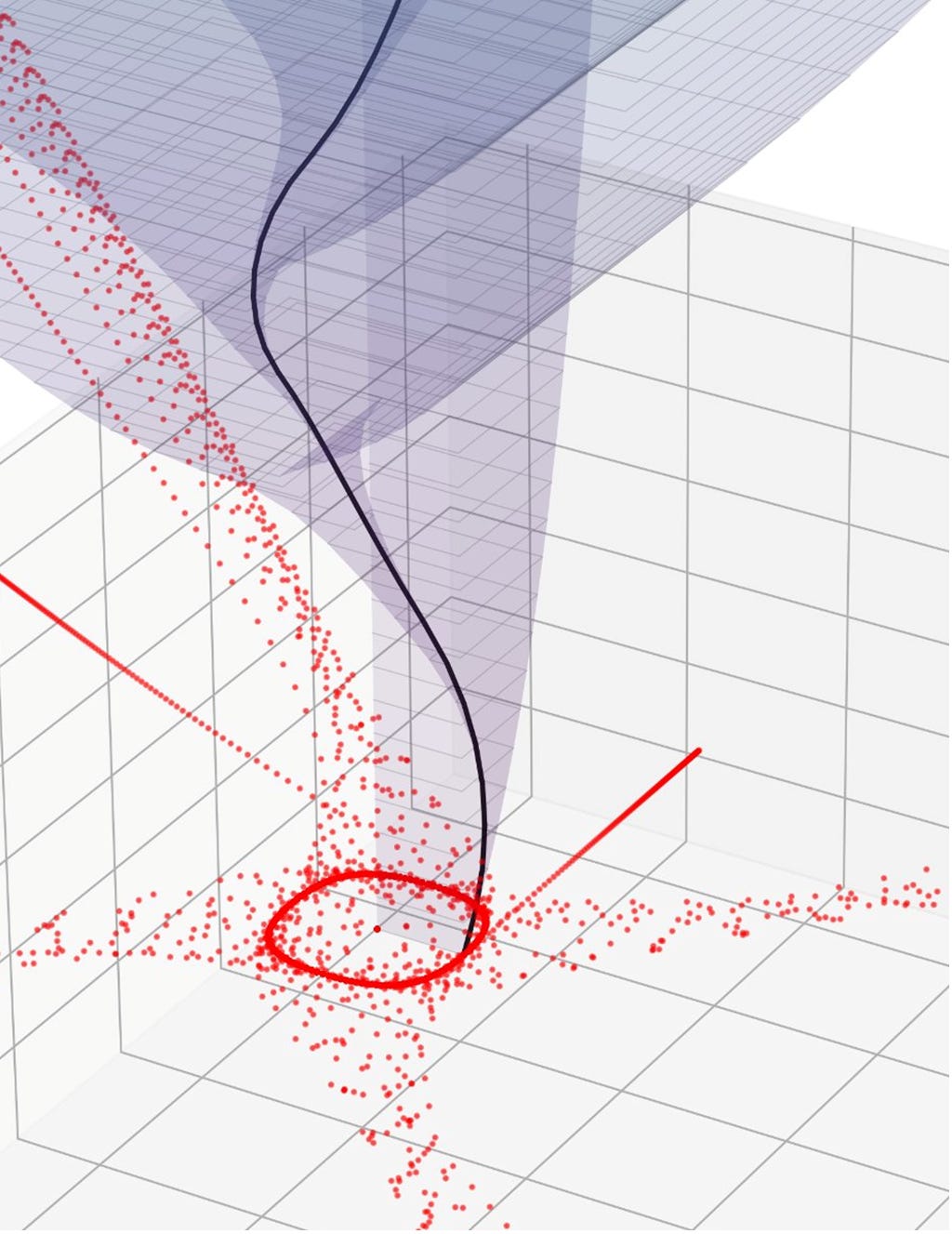
SFX: The chirp begins from high intense tone and then frequency lowers and intensity fades — subtle, eerie. Visually it is like a slinky being stretched more and more dense at the beginning loos at the end and blown up radius.
🟫 ACT VI — “THE COSMIC CONSEQUENCE”
ACHILLES: “You’re telling me this tiny leftover might actually do something?”
MANDARAX: It does something remarkable.
TURTLE: “It blows your mind.”
MANDARAX: And astrophysicists’ minds too.
SFX: A cosmic swell. Like the universe breathing.
🟨 ARE PHOTONS OUROBOROS? — “THE QUESTION”
NARRATOR: Mandarax turns to us.
MANDARAX (dramatic): What happens when a universe built from almost‑circles runs for 10^33 oscillations?
What does the accumulated chirp become?
A flaw? A feature? A cosmology?
We won’t answer that now.
This is the end of Episode 1.
ACHILLES (defeated): “This is evil.”
MANDARAX (smiling): That’s storytelling.
MUSIC: Fade out with a soft, curious Radiolab‑style motif.
THIS is the end of Episode 1.
⭐ Appendix
1. Zeno’s paradox is intuitive
Most people remember the story:
Achilles keeps getting closer to the turtle, but somehow never quite catches it.
It’s simple, visual, and easy to imagine.
2. Taylor polynomials and rotation drift are not intuitive
For those who heard about a Taylor polynomial it is just:
a formula
with symbols
that approximates something
for reasons that feel distant or abstract
So, the connection isn’t obvious at first glance — and that’s completely normal.
3. The connection lives at the structural level
Here’s the key idea:
Zeno’s paradox is about getting closer in many small steps
A Taylor polynomial is also getting closer in many small steps
But neither one ever reaches perfect closure
This shared structure is what links them:
Zeno’s infinite catch‑up = a polynomial chasing the exponential =
a tiny leftover in each rotation = a phase drift that builds up = the chirp
It’s a deep analogy, not a surface one.
4. Some brains compress the whole chain into one object
For some thinkers, the connection is immediate:
“Achilles chasing the turtle is the same shape as a polynomial chasing the exponential.”
But for others, that jump feels sudden — like comparing a bicycle to a violin.
Both are beautiful, but the similarity isn’t obvious unless someone points it out.
⭐ The 10‑second explanation (gentle version)
Zeno’s paradox says Achilles keeps getting closer but never perfectly catches the turtle.
A Taylor polynomial keeps getting closer but never perfectly matches the exponential.
Same pattern.
Different setting.
⭐ The 20‑second explanation (even more gentle version)
Achilles is fast
The turtle is slow
But Achilles must complete many tiny catch‑up steps
So he’s always just a little behind
Now translate:
Achilles → the polynomial
Turtle → the exponential
Catch‑up steps → terms in the series
Being behind → phase drift
Many steps → many rotations
Drift accumulating → the chirp
Once you see it, the connection becomes clear.
⭐ Mandarax’s softened explanation (for those who dislike math and AI)
“Think of Zeno’s paradox.
Achilles keeps getting closer to the turtle, but never perfectly catches it.
In math, something similar happens when we approximate a rotation with a finite formula.
The formula gets close, but never perfectly matches the true rotation.
Each turn leaves a tiny leftover — like Achilles being just a little behind.
If you repeat that tiny leftover many times, it adds up.
That buildup is what we call the phase chirp.”

